
In most cases, the indentation step of a PIP test does not induce fracture, and no information on fracture behaviour can be obtained from the test. In the case of some particularly brittle metals, some cracking can be induced during indentation, typically extending radially out from the indent. An example of this is shown in Figure 1(a), whilst a typical indent where the material has undergone purely plastic deformation is shown in Figure 1(b). In PIP testing, the modelled material behaviour is assumed to be purely elastic-plastic deformation with an absence of flaws assumed, so in cases where cracking has been induced from indentation, results should be treated with caution.
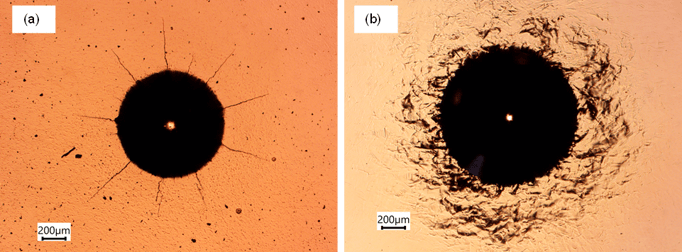
Figure 1 Optical micrographs showing indents into (a) a very brittle material showing come cracking and (b) a more ductile material which shows pure plastic deformation.
Tensile vs PIP Comparison
PIP tests are only able to derive the plasticity behaviour of a metal and cannot be used to predict its fracture behaviour. During uniaxial testing, particularly tensile testing, the test specimen may fracture before necking. This ‘premature fracture’ behaviour is not predicted using PIP. However, a comparison of plastic deformation can still be made between the PIP-derived stress-strain curve and that derived from uniaxial testing, as can be seen in Figure 2. The two curves show good agreement in the yielding and work hardening behaviour up to the point of fracture.
Care should be taken when comparing the UTS values derived from PIP and from tensile tests of brittle materials. Since PIP is deriving purely plasticity behaviour, the derived UTS value refers to the stress at the point of necking (the peak in the nominal stress-strain curve). In the case of brittle materials, the necking point may not be reached during tensile testing, so the UTS may be stated as the stress at the point of fracture.
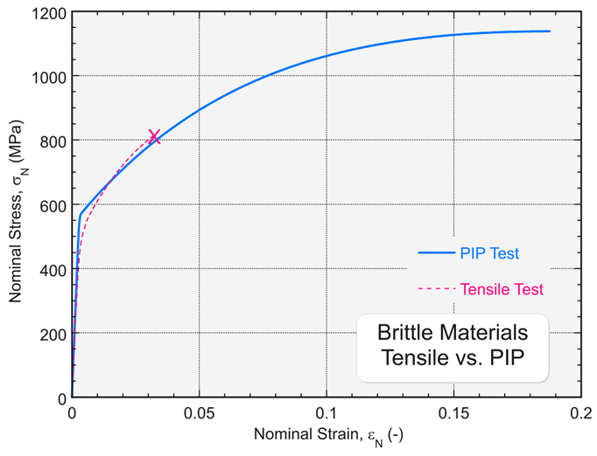
Figure 2 Nominal stress-strain curves from PIP testing and tensile testing for a brittle material which has undergone 'premature fracture'.