Mechanical testing methods such as tensile testing are known as uniaxial testing methods since they probe the mechanical properties of a material in a single direction. The stress fields generated within the gauge section of a tensile test coupon will be uniform throughout, up until the point of necking in a tensile test.
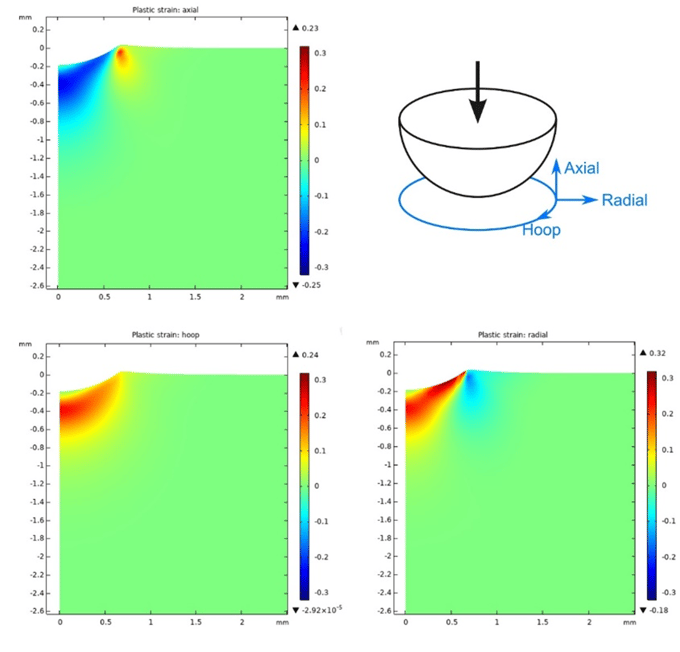
In comparison, the stress fields generated from indentation during PIP testing are multi-directional. The figure below shows the plastic strains generated in a material during indentation in three principal directions (axial, radial and hoop) derived by Finite Element (FE) modelling. These show that significant plastic strains are generated in all three of these directions. The mechanical properties in all three directions will therefore affect the outcome of the PIP test.
When carrying out a uniaxial test of an anisotropic material, the mechanical properties in different directions can be measured by carrying out tests in these directions. Since during indentation, the deformation is multi-directional, indenting in different directions does not directly derive the stress-strain curve in the indentation direction, rather a direction-averaged response is derived.