
Metal oxides commonly form on the surface of metallic samples. These oxide layers can be very thin (~10-40 nm on stainless steels). However, in cases where a sample is particularly susceptible to oxidation or where it has been exposed to high temperatures (such as in the PLX-HotStage), the generated oxide layer can be much thicker.
The presence of an oxide layer will only have a significant impact on PIP test results when the oxide layer is greater than a few microns thick. This is to be expected since the mechanical properties of the ceramic oxide will be different to the underlying metallic material, hence the test outcome will differ when deforming a significant volume of oxide on the scale of a PIP indent. An oxide of this thickness will result in significant tarnishing of the sample surface and a polished or finely ground surface will no longer appear shiny.
The deformation behaviour of a thick oxide layer during indentation is complex, with cracking and debonding of the layer among the deformation mechanisms likely to be occurring. However, the overall effect of an oxide layer on a PIP indent is to act to restrict the piling up of material around the edge of the indent, resulting in a smaller pile up height. In some cases, it has also been found to reduce the depth of the indent.
The effect of an oxide layer on an indent profile can be seen in Figure 1(a). This shows the residual indent profiles for an indent into the same mild steel sample at 1139 N, with and without a (thick) 26.5 µm oxide layer. The test on the sample with the oxide layer generated an indent with shallower depth and lower pile up height compared to when the oxide layer was removed. The effect of this on the derived plasticity properties is typically observed as an exaggerated work hardening rate, which can be seen for the PIP-derived nominal stress-strain curves for these indents in Figure 1(b).
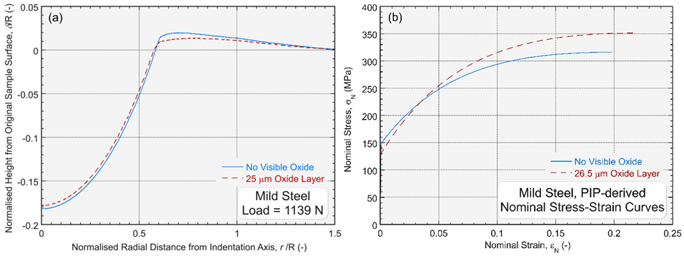
Figure 1 (a) Residual indent profiles into the same mild steel sample, with and without a 26.5 µm thick oxide layer. The nominal stress-strain curves derived from these indents are shown in (b).
What can be done to limit the effect on PIP tests?
The best way to limit the effects of an oxide layer on PIP tests is to limit the thickness of the generated layer. Although this can be difficult for samples which oxidise rapidly or which are tested at high temperatures, there are a few test procedures which can help to restrict oxide formation.
- When using the PLX-HotStage, always apply a layer of the supplied lubricant to the sample surface prior to indentation. This has been shown to reduce the generated oxide thickness on highly oxidising samples by up to half.
- Ensure any oxide is removed from the sample test surface prior to carrying out a PIP test. After a HotStage test, a heat treatment or exposure to an oxidising environment, a significant oxide layer may already be present on the sample surface. Ensure this is completely removed before starting a PIP test using appropriate metal surface preparation (e.g. grinding and polishing wheels).
- When using the PLX-HotStage, the soak time is set by the user. This soak time defines the duration at which the sample is held at the test temperature prior to indentation. If an extended soak period is not required for the test, reducing the soak time (down to a minimum of 3 minutes) will reduce the thickness of the generated oxide.