
Prior to implementing a dwell at peak load, it is important to optimise the time at peak load to each material. This document will take you through how to design the dwell testing protocol for your alloy. This protocol was developed for Titanium alloys but could be used for other strain-rate affected alloys.
1. Compare tensile and PIP data and determine whether dwell testing is necessary.
Table 1 Data showing how a slower indentation velocity can produce tensile-equivalent data
|
|
Yield stress / MPa |
Tensile strength / MPa |
|
Tensile |
914 |
993 |
|
PIP |
973 |
1076 |
|
PIP (slow) |
911 |
1012 |
In this case, the PIP results have a significantly higher yield stress than the tensile results. There is also a significant difference between PIP tests performed with different indentation velocities. Both of these effects together suggest that the tensile results are not truly in the quasi-static testing regime of strain rates (Table 1). The slow PIP test can take a long time depending on the strain rates and materials concerned, however a dwell test can produce the equivalent profile in a fraction of the time.
2. Perform dwell tests at different lengths of time
Begin to test the material using the dwell time option in CORSICA. You can repeatedly indent on the same spot if you do not move your sample between indents, keeping track of the cumulative dwell time. The initial change in depth can happen quite quickly for certain alloys. We recommend testing in increasing dwell steps up to a minute initially, testing longer dwell times if needed (Figure 1).
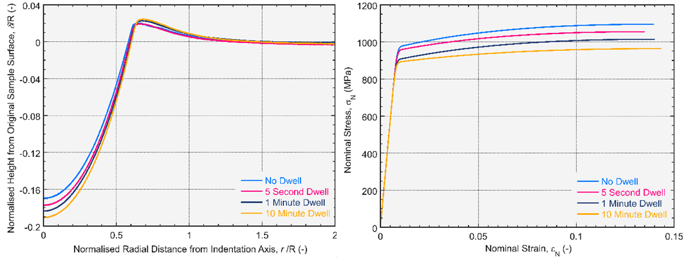
Figure 1 An example of how different dwell times at peak load can affect residual indent profiles and PIP-obtained stress-strain curves
3. Select the dwell time that best matches your tensile results.
In this case, a 1 minute dwell was selected to provide tensile-equivalent PIP data. The PIP results are now more consistent with the two-speed tensile test method required by the user’s testing tensile testing protocol (Figure 2).
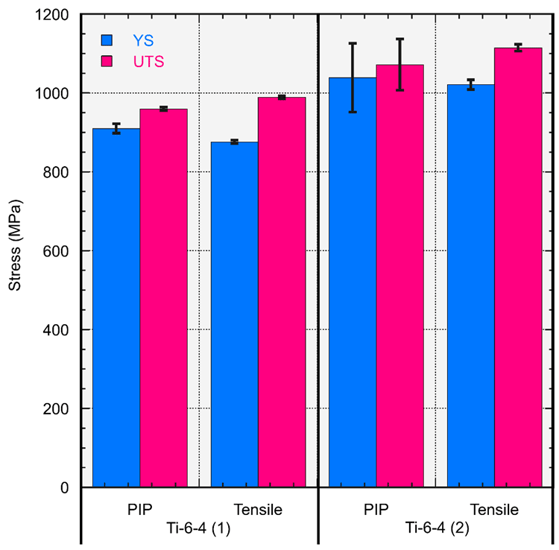
Figure 2 Results of a post-optimisation study for PIP testing two Ti-6-4 alloys to produce tensile-equivalent stress-strain data.
With CORSICA 5, you can perform PIP tests with dwell at peak load. If you are interested in optimising your test protocols to get tensile-equivalent data for certain strain-rate affected alloys, please contact you Applications Engineer (support@plastometrex.com).