Lüders band behaviour is a phenomenon often observed in the mechanical testing of low carbon steels. In these low carbon steels, interstitial carbon atoms can pin dislocations and inhibit the onset of plastic deformation. When the upper yield point of the material is reached, the dislocations escape these pinning carbon atoms (known as Cottrell atmospheres), resulting in a load drop and burst in plastic straining at constant load.
The Cottrell atmospheres generated by the interstitial carbon atoms are crucial for this type of behaviour. As a result, the Lüders band behaviour is usually only observed in low carbon steels, rather than other alloy types.
Effect on PIP vs Tensile Comparison
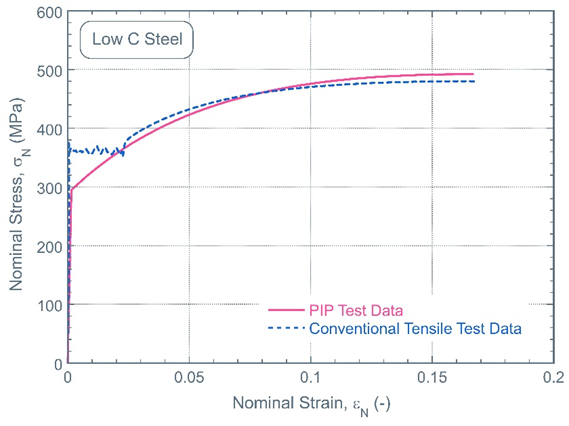
The plasticity behaviour modelled during a PIP test uses a constitutive plasticity law (the Voce equation) to describe the true stress-strain relationship of the tested material. The Lüders band behaviour (strain bursting) is not well characterised by this true stress-strain relationship. That is not to say that PIP testing is ineffective in deriving the stress-strain curve for mild steels. As can be seen in the figure below, the work hardening behaviour of low carbon steels can be well captured by PIP. However, the PIP-derived yield stress is likely to be lower than the peak yield stress observed from tensile tests on materials which exhibit strain bursting behaviour.