
During mechanical testing, some metals undergo phase transformations. The effect this can have on the results of a mechanical test depends on the nature of the phase transformation and the type of testing performed. For 300 series steels, there is a transformation from austenite to martensite, which causes a positive volume change. This means that the transformation is promoted in tension but suppressed in compression (therefore supressed during indentation). In some cases, this can result in a “sigmoidal” stress-strain curve during conventional mechanical testing, which cannot be described by the Voce constitutive law in the Finite Element (FE) model which is used in the PIP process (figure below). For some alloys undergoing phase transformation in mechanical testing, including 304 and 316 stainless steels, the stress-strain curve is “non-sigmoidal”, but the phase transformation still takes place, resulting in real differences between the mechanical response of the material in tension and during indentation.
In most cases, the tensile stress-strain curve is taken as the “real” stress-strain curve. However, it is necessary to understand that the tensile stress-strain curve is not necessarily the universal stress-strain curve for all loading conditions and may not be the most appropriate choice for certain use cases.
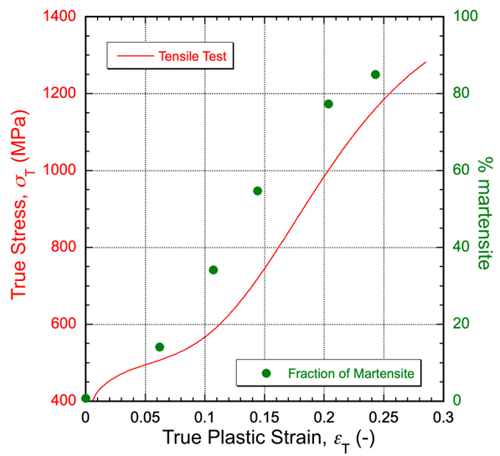
True stress-strain curve of 301 stainless steel in tension with proportion of martensite shown (this work is done in conjunction with the University of Pretoria).