
The PIP methodology uses Finite Element Method (FEM) modelling, a powerful numerical method that can be used to analyse complex physical phenomena that cannot be analysed using analytical expressions. The FEM divides a large system into small parts, called finite elements. The partial differential equations that define the physics of the problem can then be solved in each of the finite elements, using numerical methods. This allows complex processes to be simulated for a defined set of input parameters and boundary conditions. In the inverse analysis procedure, the FEM can be used to determine these input parameters via an iterative refinement procedure. PIP employs this method to determine the (unknown) plasticity parameters of metallic materials.
The model in PIP uses the Voce Plasticity Law to define how the material behaves plastically. The Voce Plasticity Law takes the form shown in the equation below:
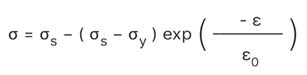
Where σ is the true stress, ε is the true strain, σY is the yield stress, σS is a saturation stress and ε0 is a characteristic strain (this is not the same as ductility, and it is not a uniform elongation strain). After extensive experimentation, it has been found that this law captures the plasticity characteristics most effectively for most metals.