Representative volume refers to the volume of material that is being probed during an indentation test in relation to key microstructural features (principally grain size). This volume must be large relative to these microstructural features to ensure that the material response reflects that which would be measured in a macroscopic tensile test. For PIP testing carried out with the 1 mm radius indenter tip, problems are likely to arise if the average grain size is larger than ∼500 µm. For the 0.5 mm radius indenter tip, this reduces to 250 µm and for the 0.25 mm radius indenter tip, this reduces to 125 µm.
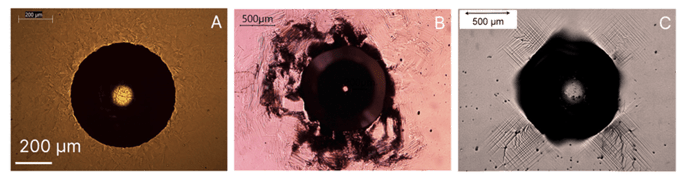
For most materials, the grain size will commonly be smaller than this. With very coarse grains, such as those often found in castings, there may be point-to-point variations in indentation response, and radial symmetry is often lost. This leads to errors in the PIP inferred properties. The limiting case of a single crystal will not show point-to-point variations, but is likely to exhibit strong anisotropy, so these are not suitable for PIP testing. The images below show indent micrographs from a material with an appropriate grain size (a), a material with grains that are too large (b) and a single crystal (c).