
Some metallic materials show a dependence of their plastic deformation on the strain rate of testing. This is true for both PIP and uniaxial testing, with similar effects observed for both. As a result of this, it is important to compare results from the two techniques at similar strain rates. For uniaxial testing, identifying the strain rate is straightforward, however the same is not true for indentation testing. Due to the complexity of the strain geometry below the indenter (Figure 1), it is impossible to identify a single test speed. Strain at maximum load peaks around 40%, with a small region above 20%. These higher strain regions have an average strain rate around 10-2 for a 30 second indent although the strain rate for the bulk of the material is much lower.
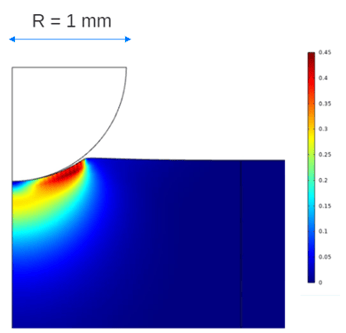
Figure 1 Strain geometry below an indenter.
The rate of deformation changes throughout the test. At the beginning of a simulated indentation (Figure 2), strain rates peak at 1.8x10⁻¹ s-1 in a small area beneath the sample, whereas during the final part of loading (Figure 3), strain rates at the edge of the indent peak at around 8x10⁻² s-1. This again is in contrast to the constant strain rate seen in tensile testing. It is perhaps more reasonable to consider an envelope of strain rates that occur during a PIP test. This envelope of strain rates is not identical between different materials. For materials that show limited work hardening, deformation is more concentrated, resulting in higher pile up and higher maximum strain rates.
The rate of indentation can be reduced in the CORSICA software to match slow tensile testing speeds more closely for those materials that show a strong dependence of plastic deformation on strain rate.
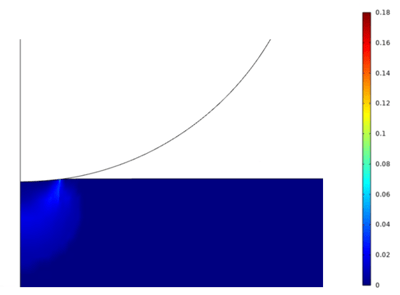
Figure 2 Strain rate geometry below an indenter at the start of indentation.
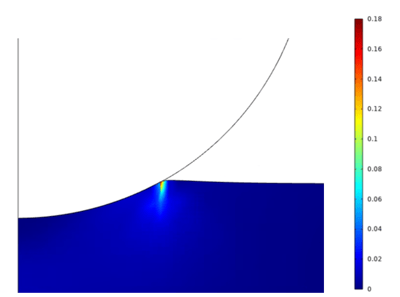
Figure 3 Strain rate geometry below an indenter at the end of indentation.
In the case of Ti-64, it is observed that slowing the strain rate has a larger effect on the yield stress and smaller effect on the UTS, with slowing testing resulting in a reduction of the measurement of both properties (Figure 4). It is important to note that yield stress and UTS should be measured at sufficient testing speed that time-dependent deformation is not occurring, to ensure correct plasticity parameters. For this reason, Plastometrex recommends use of the standard indentation velocity. However, many industry standards require testing at a slow speed which can allow time-dependent deformation to occur. It may also be advantageous to test at lower speeds to match with previously acquired data, for example for quality assurance purposes.

Figure 4 Nominal PIP-inferred stress strain curves at three different strain rates for Ti-64.
CORSICA 5 allows for the selection of indentation velocity under advanced indentation parameters. Please contact you Applications Engineer to gain access to this feature (support@plastometrex.com)