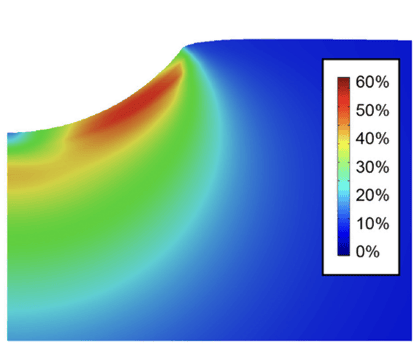
The stress and strain fields below an indent are always non-uniform. The distribution and magnitude of the plastic strains is an important consideration during PIP testing, as the intention is to characterise plasticity behaviour to high plastic strains. This is particularly important for materials with high-work hardening rates, which can neck at relatively high nominal strains. In this case, we must be sure that we are generating strains beneath the indent that are commensurate with these high strain levels.
For indentation with a spherical tip, the magnitude of the plastic strains will depend on two characteristics:
- The depth of indentation, often expressed as a ratio with respect to the radius of the tip. The higher the penetration depth (as a percentage of the radius) the higher the plastic strains.
- The work-hardening characteristics, whereby for a given penetration ratio, the peak strains will be higher in materials with lower work-hardening. As a result of this consideration, CORSICA has built-in testing protocols to ensure a suitable indentation depth is achieved for each material, such that we can be confident in the robustness of the inferred plasticity parameters.