
Some metallic materials show transitional yielding behaviour in the nominal stress-strain curves obtained by uniaxial testing. This behaviour consists of a gradual transition from linear elastic deformation to plastic deformation, rather than this transition occurring at a clearly defined point.
Despite this gradual transition from elastic to plastic deformation observed in some materials, the yield stress derived from uniaxial tests is still commonly quoted as a specific number. This number is typically derived by taking the elastic gradient and offsetting a line with equivalent gradient by a certain value of strain. The point where this offset line intersects the measured stress-strain curve is taken to be the yield stress. The most used strain offsets are either 0.2% or 0.5% strain. In the case of a material which shows particularly transitional yielding behaviour, the yield stresses derived by either the 0.2% or the 0.5% offset can differ significantly.
The Finite Element Method (FEM) simulations used in the PIP method assume a discrete stress value where the behaviour transitions from elastic to plastic deformation, i.e. non-transitional yielding. This yielding point is derived using inverse FEM as a yield stress parameter within a constitutive plasticity law (the Voce law).
For materials which show transitional yielding, PIP is still able to derive reliable stress-strain curves which agree well with the uniaxially derived curves. However, if the PIP derived yield stress is directly compared to 0.2% offset uniaxial yield stress, there may be an apparent discrepancy (where the PIP-derived yield stress is higher). This is because the transitional nature of the uniaxial yield stress makes it more difficult to characterise by a single number. For materials with a transitional yield, better agreement with the PIP-derived results can sometimes be obtained when comparing with the 0.5% offset uniaxial yield stress. An example of this can be seen in the figure below, which compares the tensile curve of 4340 steel with a fitted Voce curve.
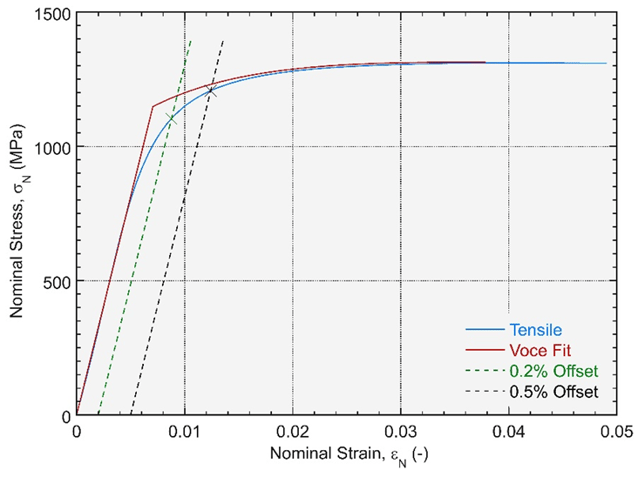 Tensile nominal stress-strain curve of a 4340 steel showing significant transitional yielding. The 0.2% and 0.5% offset lines demonstrate the difficulty defining a yield stress for this behaviour. A Voce curve fitted to the tensile curve, with a well-defined yield stress, is also plotted.