
During indentation, the material beneath the indenter will experience different strain rates depending on where around the indenter or how far from the indenter the material is. When a material experiences strain-rate effects, such as Titanium alloys or CP1 aluminium, this can seemingly cause a discrepancy between PIP obtained and tensile measured results. This is particularly true for 2-speed tensile testing protocols that go very slowly for the first few percent of strain until after yielding.
When comparing PIP to tensile data, PLX recommends single speed tensile tests that are above the range of strain rates that can show a dependency on time – the “quasi-static” regime. However, sometimes this is not possible due to internal testing protocols and the need to maintain consistency with historical data. In this case, the PIP testing protocol can be adjusted with the assistance of PLX’s application engineers.
One way to improve agreement is to slow down indentation speed which will generate a response similar to the tensile results, however this can prove burdensome due to increased testing times. An alternative method to produce PIP data that matches historical tensile data is to introduce a short dwell at peak load during indentation. At peak load, the material will continue to deform slowly due to creep effects that are causing the discrepancy in the first place (Figure 1).
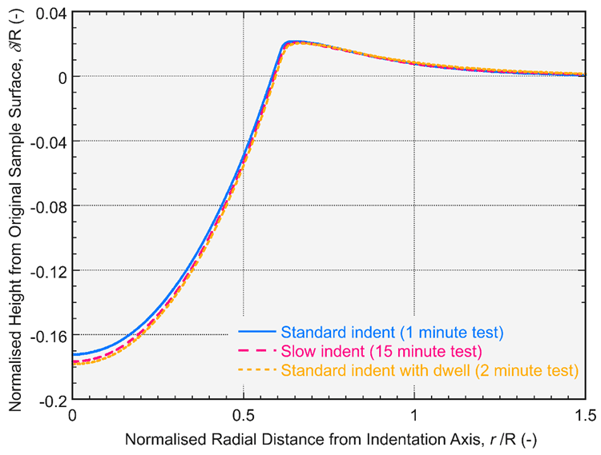
Figure 1 Example of how the profile of indentation testing can change with a slower indentation velocity or a dwell at peak load is performed.
Click here if you would like to learn how to optimise dwell times to obtain tensile-equivalent data.